
Week 1. January 2025. In the first weekend of 2025, we were up early and on the road by 7am to collect our new camper van. Heavy snow was forecast across the country later in the day, so we were keen to do any travelling sooner rather than later. If you read our vans ‘introduction‘, you’ll know we’d previously viewed the van and put down a deposit, so once we’d arrived it was a simple matter of transferring the remaining balance to the current owner, sorting the V5 (which thankfully can be done online these days), and getting the vehicle taxed. It’s so much handier being able to do all this online nowadays! Within minutes, I was sat in the driver’s seat and heading back home, an hour and a half of assorted motorways to go, in the new van. My youngest lad chose to be my Co-driver, and my eldest stayed with my husband in his car, who’d kindly driven me up (again)!
Thankfully, the journey home was uneventful. This is always the nerve racking part with a new car purchase! No warning lights came on, no overheating, no breakdowns, and no snow. Phew! I did discover, however, that both wipers were in desperate need of replacement, the drivers side seat height adjustment lever is missing and a pin is missing on the fuel filler flap. The coolant cap is also busted. The shopping list begins 😂
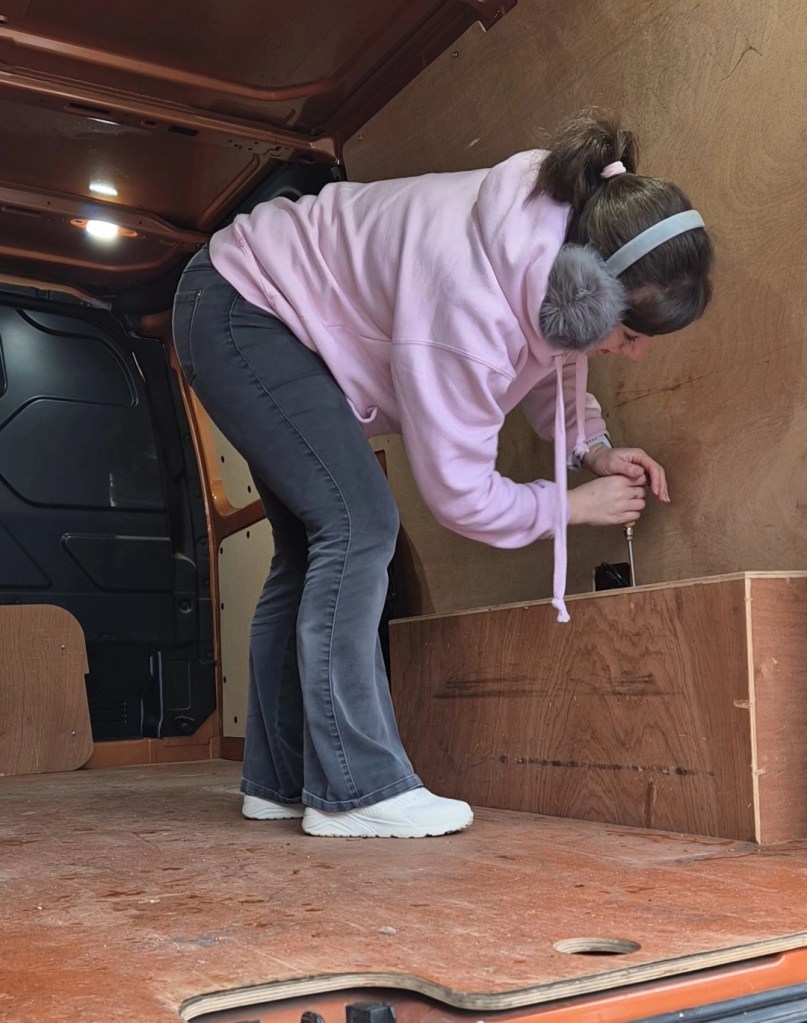
Once home, despite the temperature barely hitting 0°C, I was keen to start stripping the van. Realistically, there isn’t much to do right now. I’ve spoken to a local converter who’s willing to work with me on a ‘hybrid’ build, so to speak. By that, I mean he’s willing to do all the bits I can’t do and allow me to do other bits I can, which is amazing because I really want to do as much as we can. Fitting a pop top roof is a safety matter and there’s no way I’m taking an angle grinder to any panel on this van 🤣. The first big job will be the pop top (and possibly windows, as I’m too nervous to attempt this!), but the lead time is at least 6-8 weeks, with still no solid date (or quote!) in place yet, so I have plenty of time to do the stripping and cleaning!
The van has 2 layers of ply, flooring and a bulkhead that I need to remove and clean before she goes in for the pop top. In my impatience I have removed the outer ply board and discovered underneath the original ply, all lovely and new, and perfect for me to cover in carpet, so at least I won’t have to cut new ply! The wait until I can do some more is going to kill me 😂. Naively I thought pop tops would be sat on the shelf in a pop-top shop waiting for someone to buy, and I wasn’t expecting to have to wait so long😅. All I can do is hope that we will have 4 belted seats by the time the good weather arrives so that we can go biking. As frustrating as it is right now (because I’m dying to start doing things on the van), at least the weather is pants and no-one is missing out on biking fun! 😂
How to decide what van to buy to convert to a camper…
So, with a wealth of vans out there, you might be wondering why I chose a Transit Custom? Ultimately, budget had a lot to do with it, and I also wanted something that was big enough for 4 people, but small enough to take to the supermarket or do the school run. It was, after all, going to be my only vehicle. A Crafter was out of the question! Here are some of the Pros and Cons I considered with the “smaller” vans, and perhaps my thoughts might be useful to consider if you are looking to build a van too…
The clear choice for me was between either the popular VW Transporter, or the Ford Transit Custom. I dismissed the Vauxhall Vivaro and Renault Trafic immediately, as they are two brands I’m unfamiliar with, and I would rather maintain and work on vehicles I know a bit more about (I’m a very hands-on kinda gal!).
Here are some cons and pros of the two vans I was considering:
FORD TRANSIT
PROS:
- More affordable
- Often lower miles for my budget
- More driver luxuries such as Air con, heated seats, heated screens, sat nav
- Later ones with the body kit look quite smart
CONS:
- To be honest, the only thing concerning me with the Transit was the engine. The “wet belt” system, especially on an engine that’s done more miles (which was all I could afford on my budget) can cause catastrophic engine failure if it’s not been looked after.
VW TRANSPORTER
PROS:
- Will always sell well/hold value
- Engines are bullet proof. I did over 250k miles in a Seat Ibiza with a PD130!
- Later shapes are very aesthetically pleasing
- Available in many nice colours
- Much more available “off the shelf” for Transporters
CONS:
- VW Tax!! Yes, it’s a thing! Astronomical price tags for high mileage examples, “because Dub” 😅
- Often high mileage in my budget
- Fewer driver luxuries – many without air con and I don’t recall seeing any with heated seats, screens or sat navs!
So, although I would have preferred a VW with the strong, reliable, engine, I’m very happy with my Transit. The ability to buy something with lower miles and within my budget swung it, even though I’m super nervous about the wet belt engine. I have enjoyed the driver luxuries already, taking the children to school in the snow and ice with the heated windscreen and seats. Amazing 😍 She’s the Limited 300 model, and I’ll go more into what this means next…
I’ve learnt a lot about vans in my search. I thought all vans were made equal, and the names just related to the model years and/or spec. With VWs I actually learnt that the T28, T30, T32 etc part of the name actually refers to the gross vehicle weight of the van! This is the maximum total weight of the van when fully loaded, including the weight of the vehicle itself, passengers, and cargo, and is incredibly important to consider when you’re planning on building a mini house inside! The number roughly corresponds to the weight in metric tons:
T32: 3.2 tons (3,200 kg)
T28: 2.8 tons (2,800 kg)
T30: 3.0 tons (3,000 kg)
I had had no idea until a friend pointed this out, suggesting I looked for T32’s. Otherwise I’d have been non the wiser – so hopefully this will be a helpful tip for someone else out there!
This made me wonder if Ford did the same thing, and sure enough they do! Ford typically lists the Gross Vehicle Weight (GVW) in kilograms directly in the model’s specifications or as part of its name. Common designations for the Transit Custom include:
- 260, 280, 300, 320, etc.
These numbers represent the GVW in decakilograms, which means:
320 = 3,200 kg (3.2 tons)
260 = 2,600 kg (2.6 tons)
280 = 2,800 kg (2.8 tons)
300 = 3,000 kg (3.0 tons)
This is what made me go for the 300 – now I know I can convert quite happily without panicking too much that I will be putting strain on the standard suspension or going over the vehicles legal limits! The Limited spec is the second highest spec, offering luxuries such as the heated seats, heated windscreen, air con and apple car play/android auto supporting sat nav touch screen. Ooooh! (As someone who’s always driven old cars, this is quite the mark of grandeur for me, even if it is just a van 😅). According to the chap who sold me the van, the only spec higher is a “Sport”, and that just offers leather seats! (Obviously, for the real van geeks out there, I know there is the MR-ST, but that is a whole other level haha 😂)
I hope this has been interesting, and perhaps even helpful for anyone looking. There is a whole learning curve to being a van driver – don’t even get me started on the varying speed limits across England, Scotland and Wales… 🫠
Discover more from Treks, Trails & Travel
Subscribe to get the latest posts sent to your email.

You are a very hands on kinda gal, and you’re not hanging around! 😀
LikeLiked by 1 person
Ahh yes I’m very hands on, I love doing this kinda thing and I can’t wait to get into the conversion, so exciting!! 😁
LikeLiked by 1 person
If you’re worried about the cam belt get it changed, might cost a few hundred but for peace of mind…..
LikeLiked by 1 person
We do have a receipt saying it was done last year, however I’m considering doing it again later this year once we’ve concerted her. As you say, peace of mind 😇
LikeLike
Concerted, honestly 😂 converted!!
LikeLiked by 1 person
Ooh this is sounding quite exciting!! Looking forward to seeing the progress over the year 😀
LikeLiked by 1 person
It really is SO exciting! I have to keep pinching myself that I’m actually really doing this 😂 Thank you 🙂
LikeLiked by 1 person
Good luck with your conversion of the van.
LikeLiked by 1 person
Thank you! It’s going to be interesting, hard work but hopefully also a lot of fun 🙂
LikeLiked by 1 person
You are so much braver than me tackling the some of the conversions yourself. Even though my Dad was an Engineer he didn’t pass any of his skills to me and I’m useless at anything practical. No common sense and no patience is a bad combination!
Building it yourself gives you complete freedom to choose the features you want to suit the budget. When we had ours converted it came with all the trimmings as it were. If I were to choose the items I don’t think we could live without it would be the combination of roof mounted solar panel and Lithium Leisure Battery and the blown air heater than runs off the diesel tank. The former allows us to manage without an electrical hook up for several days with careful use and the latter means we can use the van on cold winter weekends (like last weekend)
All the best with the conversion work and really looking forward to seeing how you get on over the coming months
LikeLiked by 1 person
I do love a good hands on project! 🙂 I agree, doing it myself means we can choose what we want and what’s important at the time – for instance, working to a budget, my priority it getting the seats in, the storage and kitchen etc can be added as and when funds become available, whereas if we had to pay for it I’ll suspect we’d have to have it all in one go 😅 I love your recommendations though, it’s always so helpful to hear what other vanners recommend as we’re new and have no idea what would be beneficial and what’s just gimmicky! Going off grid would be a benefit for us too so I’m taking those ideas on board – and the heater for sure because I’m a wimp when it comes to the cold 😂
LikeLike
Other stuff we have that I’d consider not essential. Electric step (complete waste of money), shower (never used it in 3 years), Fridge (handy but small and a big drain on the battery when off grid). If you put 240v supply in then extra 240v sockets are really handy. Lots of 12v sockets handy for charging phones etc. Gas supply just do some research about availability of replacement canisters as some can be devilishly hard to get hold of. We have a refillable LPG canister which is handy and much cheaper to refill but likely to be higher cost up front. Electrics is the big complex beast in terms of how batteries are charged and how you can monitor status. Hope all that helps! I’m a bit obsessive about campers as you can tell
LikeLike
Oh no this is great thank you! I’m glad you said that about the step, other people rave about them but the price makes me sad 🙃 I think we’re going to try to do both 12v and 240v, as it makes sense. And wise words on the gas, I’ve no idea about gas, and I don’t want to be in a place where we can’t get replacements or that they cost the earth to replace! Lpg – I didn’t realise was an option, will look into that! Thank you 🙂
LikeLiked by 1 person