
Let’s be honest – when your child starts biking, the first thing you picture is them grinning ear to ear. The second thing you picture is them faceplanting into a bush.
That’s why the humble helmet isn’t just an accessory – it’s an absolute must. But which one is actually the safest? What’s the difference between a standard bike helmet and a full-face mountain bike helmet?
If you’re asking those questions, you’re in the right place.
Here’s everything I’ve learned (the easy way and the hard way) about choosing the best helmet for children, with facts, fit advice, and tips that’ll help you feel confident next time you’re hurtling down a trail – or just wobbling to the park.
Why Kids’ Bike Helmets Matter So Much
Let’s start with the big one: head injuries are one of the most common types of biking accidents for children. But here’s the good news: according to Headway UK, helmets can reduce the risk of serious head injury by up to 70%. So helmets really are a no-brainer (pun intended!)
And unlike grazed knees or lost water bottles, heads aren’t so easily fixed. So yes, a helmet really is non-negotiable. The question now is – which one?
Types of Helmets for Children: What’s the Difference?
There are three main types of helmets for children. Which one you need really depends on the kind of riding your child is doing.
1. Standard Bike Helmet (Half Shell)
✅ Best for: pavement rides, parks, cycle paths
These are lightweight, well-ventilated, and come in lots of fun colours and patterns. Perfect for balance bikes and school commutes.

2. Multi-Sport Helmet
✅ Best for: scooter + skatepark + cycling combo children
These have more coverage at the back of the head and tend to be a bit sturdier. Great all-rounders, especially for active children who swap between sports.
3. Full-Face MTB Helmet
✅ Best for: mountain biking, pump tracks, downhill trails
These offer full head and jaw protection, and many now come with removable chin guards. They’re bulkier but ideal for children pushing their limits on bumpy or technical terrain.

Key Safety Features to Look For
Technology is always changing – let’s break it down here. These are the features that make a difference:
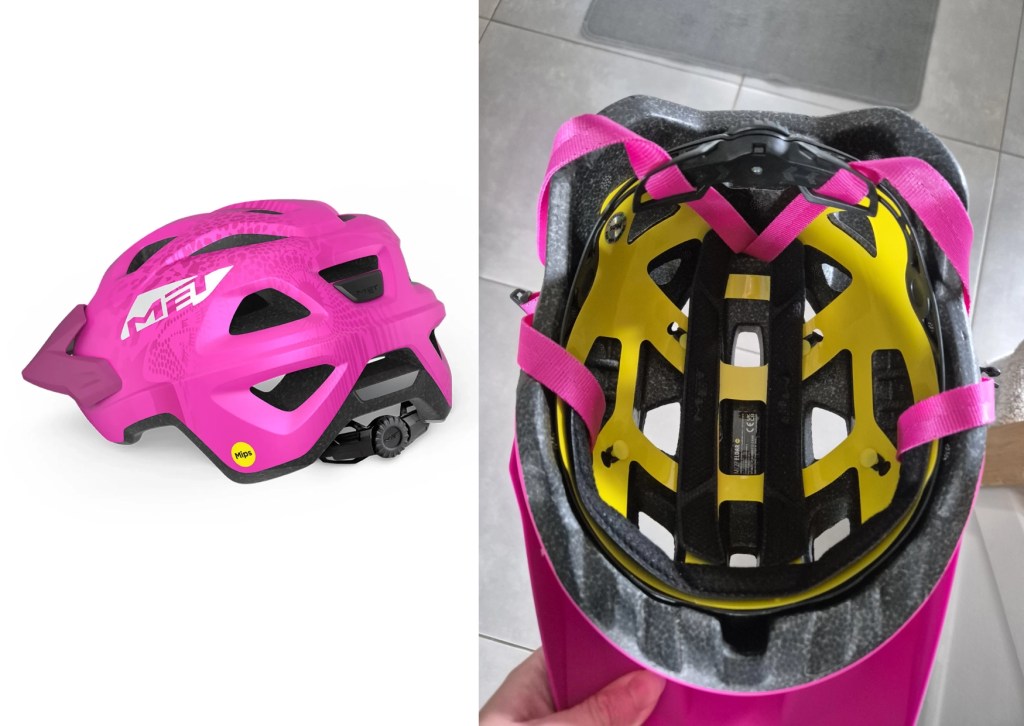
- MIPS (Multi-directional Impact Protection System): A sliding layer inside the helmet that helps reduce rotational forces during angled impacts. It’s becoming the gold standard for children’s helmets. You can identify a genuine MIPS helmet by a yellow cage like interior and an immovable yellow circular sticker on the exterior of the helmet.
- EPS foam: This absorbs impact by compressing. Check that the helmet complies with CE EN 1078 (UK/EU) or CPSC (US) safety standards.
- Hard outer shell: Look for polycarbonate shells fused to the foam (in-mould construction). They’re lighter and more durable.
- Ventilation: Essential for hot days, long rides, and sweaty heads. No one wants “helmet hair tantrums.”
- Fit system: A dial-adjustable system at the back is a game-changer. It keeps the helmet snug as your child grows.
How to Get the Perfect Fit (Without the Fuss)
It’s not just about buying a “child’s size.” Fit is EVERYTHING. Chatting to other Mums and Dads, and the general consensus is that one style that is comfortable on one child doesn’t necessarily mean it will be for another. I’d recommend getting to a store to try some on, but I also know this isn’t always possible, and not every local store will have a good selection. One parent suggested buying from different stores and returning those that were no good – be sure to check return policies first though!
Here are some things to check:
- Position: The helmet should sit level on the head, just above the eyebrows – not tilted back like a sunhat.
- Straps: They should form a “V” shape around the ears and buckle snugly under the chin (you should be able to fit one finger underneath).
- Wiggle test: If the helmet moves when your child shakes their head, it’s too loose.
- Measure your child’s head: If you can’t get to a store, you may need to measure your child’s head. Use a flexible tape measure, or a piece of string, and place it around their head: Start about an inch above their eyebrows and wrap the tape/string around their head ensuring it stays level (positioning it like a halo, not an alice band) – keep it above their ears.
🛑 Pro tip: Never buy a helmet “for them to grow into.” A loose helmet is as bad as no helmet!
Best Bike Helmets by Age Group
I feel helmet types are best chosen for your child’s riding style and not by age group. However, some key points regardless are:
- Toddlers (1–3): Look for extra lightweight helmets with big rear coverage for seated carriers or balance bikes.
- Gentle rides – on the road, or light/easy trails: Half Shell. These come in a wealth of funky colourways to keep every child happy, and many include additional coverage at the back of the head (such as my pink MET one shown above)!
- Days at the Skatepark: If your child spends their entire time at the park switching between their BMX and skateboard, a multi-sports helmet would be the perfect solution.
- Mountain Biking (or crazy-kids): Look for MIPS, more coverage, and possibly consider full-face if they’re going off-road. We moved to a full-face long before we hit the trails, after our slightly crazy and overly-ambitious youngest took a serious tumble, with his chin taking the brunt of the fall!
Helmet Care: When to Replace It
Helmets don’t last forever. You should replace a helmet if:
- It’s been involved in a crash
- It’s got cracks or crushed foam
- It’s over 5 years old
- Your child’s head has outgrown it (trust me, they’ll let you know when this happens!)
Recommended Kids Helmet Brands (Tried & Tested by Parents)
Here are a few brands we’ve tried over the years:
| Brand | Great For | Notes |
|---|---|---|
| Met | Everyday biking and style-conscious children | Lightweight, stylish, often includes MIPS (double check though, many versions have a MIPS and non-MIPS version – the price difference is usually a clue!) |
| Seven iDP | Affordable Full-face MTB | Perfect for trail-riding daredevils |
| Cratoni Madcat | Super Light Full-face MTB | Ultra-light and comes in some funky colours. Removable chin protection. |
Met [Style: “Eldar”] – I use a childs “youth” MET half-shell with additional coverage at the back of the head. (See the pink helmet shown under the “MIPS” section above). Having a small head has its uses! This helmet is lightweight, and comes in so many funky colours. It’s comfortable and includes a size dial. Most importantly, it includes MIPS. Be sure to double check in-store that it includes the official yellow sticker and internal yellow cage, and if you’re buying online check the photos and double check descriptions. With this helmet (The “Eldar”) there is a MIPS and non MIPS version – I almost bought the wrong one thinking I had found it £20 cheaper – then realised it didn’t have MIPS! Previously the boys had MET helmets and they sure took impacts well when tumbles happened.
Seven iDP [Style: “M1”] – The youngest took a tumble a few years back, with his chin taking the brunt of a nasty fall. He got lucky and with some support from local walkers and a paramedic with steri-strips, we got his chin patched up and skin pulled back together, but I made the decision that a helmet with chin (and teeth!) protection was the way forward for this little speed demon! We purchased both boys a Seven iDP helmet, which are massively affordable and have been really comfortable for both our lads. These are great, strong helmets and have been great for road riding, but there is one issue that we are now discovering – they are no good now we are doing lots of sweaty uphill climbs! Cue…
Cratoni [Style: “Madcat”] – In the search for a lighter full-face helmet in children’s sizes, I discovered a group on Facebook – “Little Rippers MTB“. It’s full of helpful and kind Mums and Dads of, well, Little Rippers, who were brilliant in directing me to their recommendations on light weight full-face helmets. One such recommendation was the Cratoni Madcat. Unhelpfully only available in Europe, meaning I had to order from Spain (you guessed it, through Bike Inn) – I did manage to get two to the UK. Unfortunately I didn’t get the choice of colours you can get in Europe, but my two lads are loving this well ventilated, super lightweight (450g!) youth sized helmet! It also features a removable chin guard, converting into a half shell for lighter biking days – Thumbs up from us!
👉 We had lots of suggestions of different brands, if you’d like a post listing some of them, please let me know!
Final Word: Don’t Skimp on the Lid
It doesn’t matter if they’re cruising to the corner shop or shredding down a red trail – a good helmet is one of the best investments you’ll ever make. And once you’ve found the right one? Peace of mind and big smiles all around. If you’re struggling to afford a helmet (or have several heads to cover!) consider using websites like Tredz, that offer 0% interest options to help spread the cost over a longer time.
Got questions or a favourite helmet brand you swear by? Pop it in the comments – I love hearing what works for your little explorers.
Related Posts You Might Like:


Discover more from Treks, Trails & Travel
Subscribe to get the latest posts sent to your email.

This is informative, EJ. My nephew and niece only bike in the dryer near our house, so they didn’t wear helmets. But, your advice is so helpful. Stay safe on your adventures.
LikeLiked by 1 person
Thanks for taking the time to comment Hazel, I’m so glad it was informative 🙂
LikeLiked by 1 person
It’s my pleasure, EJ
LikeLiked by 1 person